
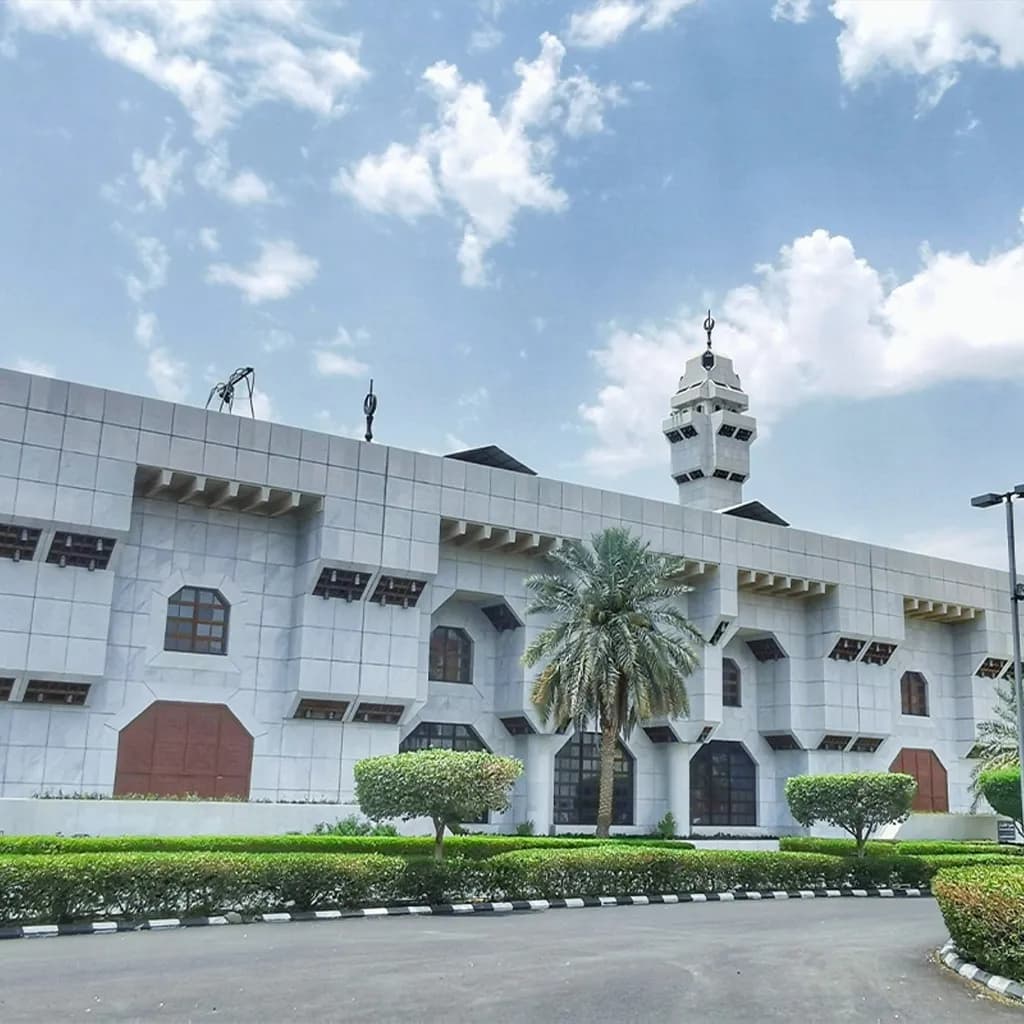
Aisha Mosque (Masjid e Taneem)
Makkah Al-Mukarramah
Aisha Mosque (Masjid e Taneem)
A prominent mosque in Makkah, situated 7 kilometers west of the Holy Mosque, serving as a Miqat for residents of Makkah intending to perform Umrah.
Masjid e Taneem, also commonly known as Aisha Mosque, is one of the distinguished mosques in Makkah. It is located in the western part of Makkah, approximately 7 kilometers away from the Holy Mosque. It serves as a Miqat for the residents of Makkah, the designated station from where they assume the state of Ihram to perform Umrah. It gained its enduring fame because it was built at the exact site where the Mother of Believers, Aisha bint Abi Bakr, assumed Ihram for Umrah during the Farewell Pilgrimage in the 9th year of Hijrah.
Naming and Origins
Some narrations mention that the reason for its name, Taneem, is due to its location between two mountains: Na'im on its right side and Nu'aym on its left. It is also mentioned that the Messenger of Allah (peace be upon him) ordered Lady Aisha (may Allah be pleased with her) to go out to this specific location to assume Ihram for Umrah during the Farewell Pilgrimage. Because of this significant event, the mosque is affectionately named after her.
Description and Prophetic Tradition
The mosque was built at the site where historical narrations state that Aisha (may Allah be pleased with her) performed Umrah after the Farewell Pilgrimage alongside her brother Abd al-Rahman, as she was initially unable to perform Umrah upon arrival in Makkah. In Sahih Muslim, Aisha (may Allah be pleased with her) narrated her experience:
"We set out with the Messenger of Allah (peace be upon him) in the year of the Farewell Pilgrimage and assumed Ihram for Umrah. Then the Messenger of Allah (peace be upon him) said, 'Whoever has a sacrificial animal with him should assume Ihram for Hajj along with Umrah, and then not terminate the state of Ihram until he has completed both of them.' She said: I arrived in Makkah while I was menstruating, so I did not perform Tawaf around the House or between Safa and Marwah. I complained about this to the Messenger of Allah (peace be upon him), and he said, 'Undo your hair, comb it, assume Ihram for Hajj, and leave Umrah.' So I did that. When we finished Hajj, the Messenger of Allah (peace be upon him) sent me to Taneem, and I performed Umrah. He said, 'This is the place for your Umrah.'"
Construction and Architecture
The mosque was originally built during the reign of the Abbasid Caliph Al-Mutawakkil in the year 240 AH on an area of 6,000 square meters. Over the centuries, most of its historical parts were destroyed. Later, it was significantly rebuilt and expanded in modern times until its total area became an impressive 84,000 square meters, comprehensively including its accompanying facilities and extensive courtyards.
Boundaries of the Haram
The mosque marks one of the six boundaries of the Haram, which surround the holy sanctuary like a security belt from all directions. In the northwest, the boundary of the Haram ends at Taneem. In the north, its boundary ends at Al-Ji'ranah at a distance of thirteen miles. In the east, at a distance of twelve miles, its boundary ends near Arafat. In the south, its boundary reaches Ada'at Laban at about twelve miles. Finally, in the west, at a distance of twenty-three kilometers from the Sacred Mosque, its boundary is located near Al-Hudaybiyah.
Historical Significance
The mosque became widely famous as Aisha Mosque because she assumed Ihram from the site where the mosque was built during the Farewell Pilgrimage in the 9th year of Hijrah. However, the location of Taneem holds other deep historical connections.
The place is associated with the martyrdom of Khubayb bin 'Adi, one of the six Muslims whom the Prophet (peace be upon him) sent in the third year of Hijrah in response to a request from a group of Banu Hudhayl to teach them the matters of Islam and recite the Quran. The tragic incident of his martyrdom took place after the Battle of Uhud while the Quraysh were still seething with anger. The Quraysh brought Khubayb out after capturing him. Standing bravely before his executioners, he looked at them and prayed: 'O Allah, count their number, slay them one by one, and leave not a single one of them.' He was then martyred, may Allah be pleased with him.
Furthermore, on the night of Isra and Mi'raj in the month of Rajab in the sixty-fourth year of Hijrah, Abdullah bin Al-Zubayr went out with the people of Makkah to Taneem. They assumed Ihram with the intention of Umrah after he had successfully completed the rebuilding of the Holy Kaaba.